Author Archives: cindylrodriguez

Critique Group Take 2

The first time I attended a Society of Children’s Book Writers and Illustrators critique group, I did a great impression of the Bid Red Chicken from Dora the Explorer. See this post for details. In short, I chickened out of reading from my work in progress, a young adult novel titled AESOP’S CURSE. The people sitting around the table were friendly and supportive, but it was my first group critique session ever. My nerves got the best of me, so I chose to listen and offer advice instead of put myself out there.

Well, I’m happy to report that I have shed my Big Red Chicken feathers. I recently attended a meeting of a new SCBWI writer’s group that meets closer to my home, and when it was my turn, I read the first five pages–Chapter 1–of AESOP’S CURSE.

Only a couple of people have read parts of it. My friend Matt read the first few chapters, and I had posted the first fives pages on the YALITCHAT website. I received lots of helpful feedback, which I used to nail down those crucial first chapters. My friend Stacy has read all of it so far. She’s been great, offering encouragement and letting me talk through certain scenes.

So, I have shared it with some people already. Having others read it and give me feedback doesn’t make me nervous. As a former journalist, the write-revise-edit cycle is ingrained in me. I want my novel to be in the best shape possible before I send it to my agent to read. The thing is, everyone who has read parts of it has read it on their own and then sent me comments via email. I’m used to this process.

Reading self-created work aloud in front of strangers is different and nerve-wracking. My sister, who is an artist, understands. As an undergraduate, she would reveal a piece to the class and then stand next to it in silence while everyone looked it over and prepared their comments. Awkward! But a necessary part of the creative process.

Plus, what’s the point in joining a writer’s critique group if I don’t participate fully, right?

When it was my turn to read, my voice was shaky at first. As I went on, though, I sounded less like a robot with the chills and more like my main character, Aaron. My reading fell into a rhythm, rising and falling where it needed to, emphasizing certain words as Aaron would.

When I was done, my critique group offered lots of positive feedback–Thanks!–and some suggestions. Overall, they liked it and wanted to read more. I’m excited to bring the next five pages to our May meeting and hear what the others have written!

The Struggle for Writing Time

Lately, time to write has been more elusive than ever, even though I know there are plenty of hours in a day—24, in fact. Still, 24 hours hasn’t been enough. My blog hasn’t been updated in well over a month. About a week ago, I told my friend I’d send her the next chapter of my work in progress; it was almost done. It’s still not done. Here’s why:

My day starts around 5:30 a.m. I say “around” because this depends on how many times I hit the snooze button. The morning routine involves taking care of me, my daughter, and my dog. I drop my daughter off at preschool and then race to work, where I start teaching at 7:30 a.m.

Period 2 is my prep period. Sometimes I use it to prep for class. Sometimes I am at a meeting. Sometimes a student comes in and asks me for help with an assignment. This time is never used to write. On Mondays and Thursdays I monitor a study hall during period 5. Perfect, you may think. Forty-seven minutes during which students are quiet and working. That’s an ideal time to write, right? Not so much. This is what happens usually:

Type. Type. Type.

“Yes, you may go to the bathroom.”

Type. Type. Type.

“You’re not allowed to eat in study hall. Please put the cookies away.”

Type. Type. Type.

“Boys, you need to stop arm wrestling. Don’t you have anything to study? This is study hall, after all.”

You get the picture.

My lunch period and after school time are filled with students who need extra help or meetings. On Mondays after school, I go to an in-house yoga class. Ah, yoga. Thank you.

On Wednesdays, my daughter has gymnastics for one glorious hour. I bring my laptop, but a nice woman who is waiting for her daughter usually wants to talk. Sigh.

By the time I get home, I have to feed myself, my daughter, and my dog. After dinner and before bed is a good time to get some writing in, if I am not doing laundry, unpacking groceries, catching up with friends online, or watching the news and, okay, maybe The Biggest Loser or The Voice.

Despite my constant battle with time, I have passed the 50,000 word mark on my work in progress, a YA novel titled AESOP’S CURSE. I guess I must be doing something right—finding time here and there, pounding out a few paragraphs when I can, and giving up vacations in sunny places to stay home and write. I think about the novel when I am driving to work, waiting in line at the grocery store, or folding laundry. I see the scenes in my head like a movie playing out. This way, when I do have the time to write, I know what to put down.

When I read advice for writers online, often the first item is “Write every day.” I can’t. Some of you may say, “Of course you can. Find the time.” I have tried. Writing daily doesn’t work for me. Writing in spurts or on vacation days does. At times, I have felt let down by not being able to meet the daily writing expectation, but I have come to terms it. I am a single mom of a beautiful daughter and a full-time teacher of diverse students. My time with them is important; I need to be present when I am with them.

So, I will continue to give up writing time to take my daughter to the park or help a student with a history paper that is overdue. I will continue to plan out my novel in my head and write when I can—in between study hall reprimands or on my days off. Of course, writing this way means finishing my work in progress will take longer, but that’s okay. I know I will finish this project, start something new, and continue to do the best I can with the time I’ve got.

Rejection: A Normal Part of the Publishing Process

Now that the dust from the SCBWI New York conference has settled into my bones, I have realized that one of the things I appreciated most about the experience was hearing writers talk about rejection.

Yes, rejection. Don’t get me wrong. I’m not a negative, the glass is half-empty kind of girl. I don’t relish in someone else’s misery. What I mean is, I found it refreshing to realize how common rejection is in the book business, even for already-published, well-known authors.

While my novel is on submission, I wait and hope and pray and teach every day and take care of my daughter and dog and wait and hope and pray and on and on…and then I get an email from my agent. And I’m immediately a little sad because I know what it is. If it were good news, she would call. And since I am new to all of this, I wonder if this is normal, especially since I read all of the announcements on book sites about the 23-year-old grad students whose first novels sold for six-figures at auction.

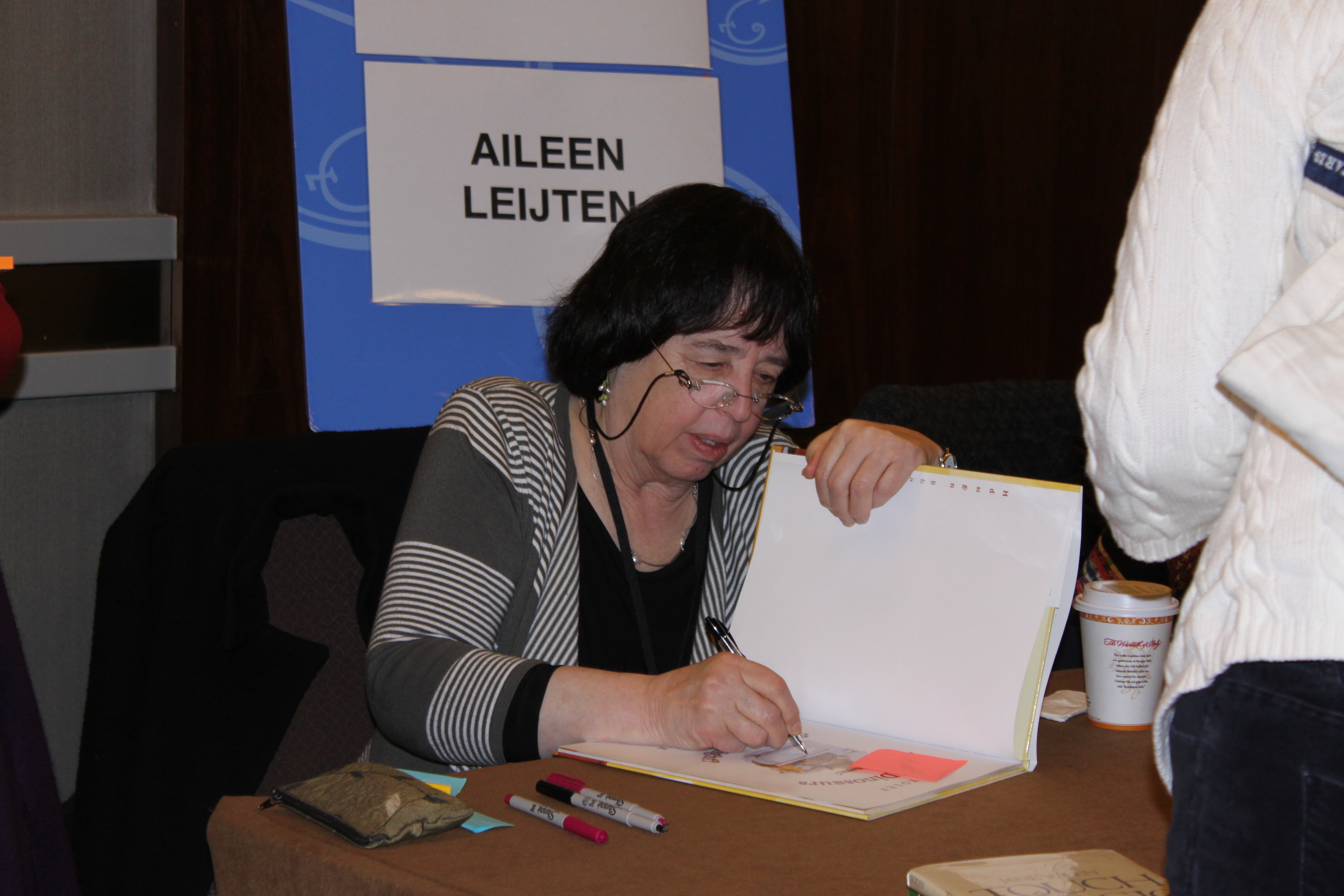
Jane Yolen signs books at the SCBWI NY conference

The SCBWI conference made me realize that rejection—lots of it—is the norm for many, dare I say most, writers. Some of the conference’s funnier moments were when writers shared their stories. Jane Yolen—THE Jane Yolen—said she still gets about two rejections per month. She said when she had a cat she would kick the cat. She was joking. I think. Now, she takes a walk or complains to her daughter, who tells her to get over it.

Illustrator Sergio Ruzzier joked that his worst rejection was delivered by a cute girl in elementary school. After that devastation, publishing rejections must be easy, the moderator replied. Ruzzier followed up by saying now, he cries for a few days after a rejection and then moves on.

Of course, I had heard some of the more famous rejection stories. J.K. Rowling was turned away by a dozen publishers before being picked up by Bloomsbury. Stephen King was told by an editor “We are not interested in science fiction which deals with negative utopias. They do not sell.” The book was CARRIE. George Orwell’s ANIMAL FARM was rejected by a publisher with this note: “It is impossible to sell animal stories in the USA.”

Hearing these stories at the SCBWI, though, was different. I think it was because I heard them while sitting in a crowd of like-minded people–people who love children’s literature and push through the creative process with the goal of being published. This time, hearing these stories made me feel like I wasn’t alone in this process–like everyone in that crowd understood, which was comforting.

Conversations I have had with other writers about rejection boil down to these conclusions: Yes, rejection hurts, but don’t let it consume you. Everyone has a rejection story, so you’re not alone. Consider the rejection. Is there anything you can learn from it? Can you glean something from the responses that could make your pitch, query letter, or manuscript better? As soon as possible, get back to work.

Dealing with rejection in publishing is really no different from dealing with let-downs in other professions or in our personal lives. We all fall down and scrape our knees. Sometimes, we suffer minor scratches; sometimes, we’re left with scars. Sometimes, we laugh about it and repeat the story so that others can nod knowingly. In the end, we get back up and move on. We get back to living and loving and working and taking care of children and pets and hoping and praying and waiting for the phone call that will deliver great news.

“The candle is you. Let it burn.” SCBWI Highlights

This past weekend, I attended my first big writer’s conference: the NY gathering of the Society of Children’s Book Writers and Illustrators. I had wavered about whether to go or not, but decided to attend largely thanks to Kimberly Sabatini, author of TOUCHING THE SURFACE, a YA novel coming out September 2012 by Simon Pulse. Kim and I “met” through YALITCHAT online. I posted there, asking if anyone was going, and Kim responded and encouraged me to go.

Imagine this as a YA novel moment: I am the new girl at the local high school. The lunch wave is fast approaching and I have no idea where to sit. Maybe I’ll just buy a Snickers bar and roam the hallways for 45 minutes. Sigh. Social isolation is averted when Kim says, “Hey, you can come hang with us.”

Me and Kimberly Sabatini (one of the nicest people ever!)

Seriously, though, Kim did not have to extend herself, but she did. She texted and emailed me, gave me her phone number, and told me to meet her the night I arrived in New York. She then introduced me to other people and recently added me to an email group of writers. How cool is she? And how thankful am I that there are people like her in the world? Because of her, I don’t feel like I just attended a conference. I feel like I joined a community, like I am a part of something.

Another highlight was meeting my agent Laura Langlie in person for the first time. She and I have spoken on the phone and exchanged numerous emails, but we had not met face-to-face. We enjoyed lunch at the Oyster Bar in Grand Central Station, where we talked about our lives and the state of my manuscript, which is on submission to editors. Being at the conference, and meeting Laura in particular, made it real to me that, “Yes, I am a part of another world—the writing world.” My daily life as a teacher and mom is so busy and thoroughly exhausting that I often feel far removed from the writing world, even though I have a novel on submission. Meeting Laura and being in New York at a writer’s conference reminded me that I already have one foot firmly planted in a world outside my daily routine. The only way to make my dream of being a published author come true is to stay focused and keep writing.

In fact, this was the exact advice that published authors, agents, and editors gave throughout the conference: Keep writing. Do not quit. It will happen. Yes, it takes time.

Here are some specifics:

Chris Crutcher signing books.

Chris Crutcher, author of many YA novels including STAYING FAT FOR SARAH BYRNES and DEADLINE: Chris, a former teacher and child therapist, effortlessly weaves tragedy and comedy. As proof of this, he made me belly-laugh and cry big tears during his speech. In the end, he said, “Just write it. Tell the best truth you can tell…The truth that you know is the one that will get you published.”

Henry Winkler, author of the HANK ZIPZER series, made a brief appearance that left the audience on its feet. In a short time, he offered genuine, enthusiastic encouragement. He talked about finding success in writing after floundering in school and experiencing a lull in his acting career. He spoke about the joy of working with his writing partner, Lin Oliver. “At the end of the day, I have six to eight pages in my hand that didn’t exist before. What a feeling!” He assured us that we will get published as long as we put “one foot in front of the other.”

Kathryn Erskine, author of QUAKING and MOCKINGBIRD, a National Book Award winner, encouraged us to stay focused and make time for ourselves and our craft. She said lots of wonderful things that made me fall in love with her. Here are a string of quotes I managed to jot down in my notebook:

“Free your mind of what you should be doing. Create a waiting room in your mind and they all need to take a seat.”

“Giving life to your craft is what you have to do for yourself.”

“Free yourself of self-doubt.”

“You’re not going to give up. Let yourself have that passion.”

“It’s hard to be creative when you’re worried about something or someone else. You have to take care of yourself. Do what you need to do to let your creative juices flow.”

“Do it your way. When I hear people say, ‘Write every day,’ I wonder, ‘Do they have kids?’” (Amen, sister!)

“Stay focused. Talent isn’t enough. You need grit. Talent and determination = success.” (I think I’ll tape this one to my wall!)

Although her words to us would have been enough, she brought hundreds of tea light candles and told us to take one home and light it as part of our getting-ready-to-write ritual. She said, “The candle is you. Let it burn. Let it remind you of your creative spirit.”

This weekend was exactly what I needed. I came back exhausted yet energized, which sounds weird but is true. My goal now is to complete my work in progress by the end of March, which is ambitious considering my full-time job as a teacher and my other full-time job as a mom. But, hey, I’ve got a sweet-smelling candle given to me by an award-winning author and lots of encouragement from family and friends–old and new.

I am the candle.

I am ready to let it burn.

Abby Sciuto, Elizabeth Davis, and Me

Me as Abby Sciuto on Halloween

What do TV’s coolest forensic specialist, a fictional YA character, and a high school reading teacher have in common?

Sounds like the beginning of a bad joke, but here’s the story.

Almost two weeks ago, I was scrambling around, trying to decide what to be for Halloween. Yes, the teachers where I work dress up, and I don’t need to be asked twice to participate in the holiday. This year, I wasn’t sure what to do, but then I decided to be Abby Sciuto from NCIS. I must be a big fan, right? Not really. I watch limited TV. Still, I’d have to be living in a cave not to know who she is. Then, I must be a big fan of Pauley Perrette’s, right? Not really. I know very little about the actress. So, why Abby? Because a teen version of her is what I pictured in my head as I developed the character Elizabeth Davis for my yet-to-be-published novel, RESURRECTING EMILY.

In my mind, Elizabeth was beautiful, tough, creative, and smart with jet-black hair and light green eyes. While writing the novel, I decided to make a mock book cover that I would pin to my wall.  I had just read THE SECRET and listened to a CD about manifesting dreams. Creating a visual of what’s desired was one of the suggestions. Some of friends will laugh about this (go ahead, ha ha), but I grew up with a superstitious Brazilian mother. If she told me to light a candle every Tuesday to ward off the evil eye, I did. No questions asked. So, I created a book cover that would make my graphic designer sister

The mock book cover I made to visualize my dream

cringe, but the point is that I chose a picture of Pauley Perrette as Abby Sciuto to represent Elizabeth. I couldn’t find a picture of a Goth teenager that captured the exact image I had of my character, but Abby as a 15-year-old–at least physically–would come close. Here is how my character is described in the novel:

Emily Elizabeth Davis: major attitude from the tone of her voice to the swagger in her walk…A Goth girl in a small, New England town. In a big city, she would blend in. But here? She stood out to say the least. She carried her attitude easily on her sturdy frame. She was taller than many girls her age and had an athletic upper-body.

Her pin-straight hair was dyed jet-black and pulled tight into a ponytail. Uneven bangs and black eye makeup framed light green eyes. Her angular face, with its strong cheekbones and jawline, was decorated with an eyebrow piercing, big black hoop earrings, and a pouty mouth painted deep purple. Loose, army-green shorts sat low on her hips. She wore black wedge flip-flops; her toenails and short finger nails were painted blood red.

Dressing up as Abby Sciuto was fun. I mean, when else could I get away with wearing a red dog collar and neck tattoo to work? But it also made me feel like I gave a little life to Elizabeth Davis, a fictional girl who’s been a part of me for many years now. Hopefully, soon, you’ll have the chance to get to know her.

Losing My Nerve

Bawk. Bawk.

Is the Big Red Chicken from Dora the Explorer guest writing today?

No.

That sounds represent me at my first ever writing critique group.

I was a big chicken. Uma galinha grande, my mom would say. Un pollo grande, my dad would say. Yes, I can be called a coward in three languages. Impressive, I know.

Truth is, I’m probably being a little hard on myself, but here’s what happened:

I decided to join the Society for Children’s Book Writers and Illustrators because I had heard great things about the organization, which has events during the year and offers local writing groups. I wanted to join a critique group for a couple of reasons. My primary reason was to meet and work with other writers. Writing is a solitary act. It’s just me and the laptop. My faithful dog might be snuggled by my side, which is nice, but he’s not great at giving feedback.

Rusty literally supporting my writing

My friends who read for me, on the other hand, are great at giving feedback, but they have busy lives. I sometimes feel guilty adding my writing to their lists of things to do. For example, my longtime friend Matt Eagan and his wife Sarah just had a baby girl yesterday. Welcome Grace Mary Eagan!! I’m not about to ask Matt to read for me at such an important time for his family.

With a critique group, I could attend and know that for a couple of hours once a month, a group of people are ready and willing to read and offer suggestions. That they are strangers is a plus since my parents will praise anything I produce. That’s nice for the ego, but I do need real constructive criticism as I write.

So, I attended my first group on Tuesday, July 19 in Hamden, CT. The second to arrive, I signed in and waited. A dozen people came. After introductions, the coordinator said we would share in the order in which we arrived. He was first to arrive and didn’t have anything to read. So, I was up.

Bawk!!

As much as I wanted to join a group, I wasn’t sure how this would go. I had heard stories, good and bad, about critique sessions. One person I know said he was kicked out of his group. Then, he said he kicked himself out. Either way, that didn’t sound good. I know that when I get published (positive thinking in effect here) I will likely get some rake-me-over-the-coals reviews. Even international best sellers and award winners get those nasty one-star critiques on Amazon and Goodreads. I get that. I would have to deal with that.

But in the moment, there in the Hamden senior center, I chickened out. It’s not that I’m not able to handle criticism. As a former journalist, I was edited daily and often had to rewrite articles multiple times. I have pretty tough skin. I think being the new girl had more to do with it. It’s like going to a party where you don’t know anyone. As soon as you walk in the door, they throw a spotlight on you and ask you to show off your best dance move. The music is blaring and everyone has stopped to watch. I’ve got some moves–at least I did back in the day–and still, I would definitely stand frozen like a deer caught in headlights.

So, I decided to pass. I wanted to observe the group dynamics first and see if I would be comfortable sharing in the future. Turns out, I had nothing to worry about. The group was positive and supportive. Those who read received helpful advice and I felt comfortable jumping in and offering some suggestions, too. My plan now is to visit some other local groups to see which one is the best fit for me. Then I plan to attend meetings on a regular basis to build connections with some fellow writers and get the feedback I need.

Next time, I won’t be such a big chicken.

Why Authors Write–According to Certain 10th Graders

Understanding an author’s purpose—why writers write—is one of the many things students are taught in middle school and high school. The CAPT, taken in 10thgrade, has lots of questions related to author’s purpose. So, instead of asking students to identify the metaphor in paragraph 2, the test may ask, “Why did the author include this metaphor in paragraph 2?”

When teaching author’s purpose, I start with these trusty reasons: to describe, to explain, to persuade, to entertain. These cover many types of writing: poetry, anything expository, advertisements, editorials, and narrative fiction.

On a test, of course, you have to give students some leeway and partial credit (at least I do) if they don’t remember them exactly, but they get the gist. For example, if the student lists “to get his point across” or “to convince others to agree with her,” I’ll take it.

Then, there are answers that make you think, scratch your head, or laugh out loud.

Question: Why does an author write? Think about the reasons we covered when talking about author’s purpose.

Answer #1: Free speech.

So, yes, we have freedom of speech and freedom of the press in the U.S. So, is this student saying an author writes because she can? Maybe. In some countries, journalists and other writers are killed because of their work. Had the student tried to convince me this is what he meant, I might have given him partial credit.

Answer #2: Their own amusement.

Love this one! When I first read this, I envisioned an author chucking aside a bad review, declaring, “I write to amuse myself. Reader be damned.” Then, I thought, this is true. I’m sure most, if not all, writers enjoy it. We write because we like to, so I guess that is for our own amusement.

Answer #3: To make money.

Yes, of course. Alas, according to all of the blogs I’ve been reading most authors will not get rich. Most will be like the musician who plays out for extra money but keeps his day job. Still, even this type of writer makes some money, so I would agree many of us write with the hope of earning some cash.

Answer #4: Bad to good or vis versu

????? I have no idea what’s going on here. No credit.

Answer #5: To help people fall asleep.

HA!! Love it!! Reading, especially at night after a long day, may lead to closed eyelids and well-deserved rest, but I doubt that was the author’s purpose. “I write so that I can put you to sleep.” Wait a minute…unless, of course, it’s a self-hypnosis type of book or a guided meditation audiobook. Hmmm….maybe this student has a point.


If you’re a writer, tell me, why do you write?

« Older Entries Recent Entries »